Blue Dreams by Lauren Slater
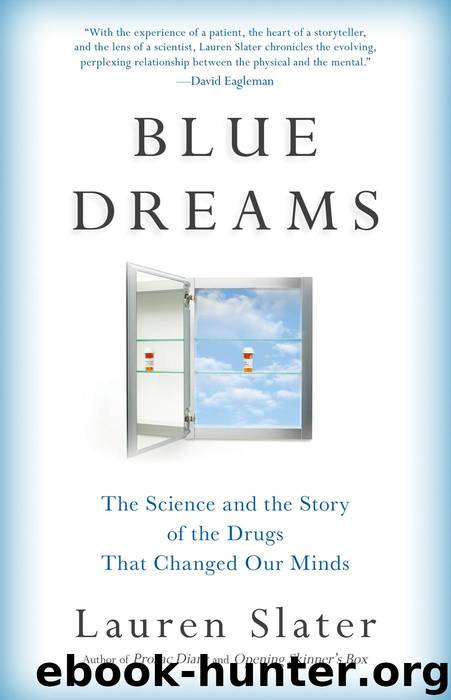
Author:Lauren Slater
Language: eng
Format: epub
Publisher: Little, Brown and Company
Published: 2018-02-20T05:00:00+00:00
Does Depression Damage the Brain?
Helen Mayberg, a neurologist and leading depression researcher at Emory University, reported in 2013 that psychotherapy, specifically cognitive behavior therapy, is just as effective, statistically, as antidepressants are in reversing depression. But what about those patients who are too sick to tolerate the rigors of reflection? Beyond that, just because we have not found a chemical imbalance in the brains of mental patients does not mean there isn’t something terribly askew in those brains, something that antidepressants could be treating, albeit in indirect or not entirely detectable ways. Perhaps, for those with a depressive disorder, raising the amount of serotonin available in the synaptic cleft triggers the DNA to make a new protein, and this altered gene expression allows a patient to recover.
Suppose we do nothing for the depressive except watch and wait for him to recover. The trouble is that myriad researchers and practitioners have suggested that depression is at least as toxic to the brain as the drugs we use to treat it. Untreated depression bathes the brain in the stress hormone cortisol, and long-term exposure to cortisol can cause the brain’s prefrontal cortex to waste. Thomas Frodl, a neurobiology researcher at Trinity College Dublin, found that depressive episodes may result in neuroplastic changes to the brain. Frodl looked at inpatients with major depression alongside controls recruited from the community, studying their brains with fMRI technology both at baseline and three years later. “Compared with controls,” he observed, “patients showed significantly more decline in gray matter density.” In other words, contra Whitaker, untreated depression may cause brain damage too. Furthermore, other research shows that the more episodes of depression a person has, the more vulnerable he or she is to future relapse. Each episode, if left untreated, damages our gray matter, quite literally shrinking our hippocampus (a ridge in the brain responsible for memory), torquing our amygdala (an almond-shaped mass in the temporal lobe that handles the emotions), and sending our neurons into chaos.
But if it is not about correcting a chemical imbalance, how else might psychotropic drugs help our brains? There is some research which posits that the reason why antidepressants take weeks to work, even though they almost immediately raise neurotransmitter levels, is that the medications, far from being toxic, are actually neurotrophic, meaning they spawn the cranial conditions that allow fresh neurons and new neuronal connections to be born. Drugs like Prozac, this research suggests, might increase branching of the dendrites in the neuron, a process that is the substrate for how we learn and feel and play. So it could be that the way antidepressants make us feel better is by helping the brain grow a richer, thicker forest of connections, which enable us to think faster and with more acuity. This line of reasoning stands in absolute contrast to what Whitaker and Glenmullen have found in their analyses of many outcome studies, which all seem to show antidepressants burning the brain. That there can be two such utterly opposing
Download
This site does not store any files on its server. We only index and link to content provided by other sites. Please contact the content providers to delete copyright contents if any and email us, we'll remove relevant links or contents immediately.
Waking Up in Heaven: A True Story of Brokenness, Heaven, and Life Again by McVea Crystal & Tresniowski Alex(37940)
Still Foolin’ ’Em by Billy Crystal(36483)
Cecilia; Or, Memoirs of an Heiress — Volume 1 by Fanny Burney(32735)
Cecilia; Or, Memoirs of an Heiress — Volume 2 by Fanny Burney(32101)
Cecilia; Or, Memoirs of an Heiress — Volume 3 by Fanny Burney(32079)
Fanny Burney by Claire Harman(26739)
Empire of the Sikhs by Patwant Singh(23212)
We're Going to Need More Wine by Gabrielle Union(19196)
Hans Sturm: A Soldier's Odyssey on the Eastern Front by Gordon Williamson(18730)
Plagued by Fire by Paul Hendrickson(17547)
Out of India by Michael Foss(17032)
All the Missing Girls by Megan Miranda(16767)
Cat's cradle by Kurt Vonnegut(15574)
For the Love of Europe by Rick Steves(14966)
Pimp by Iceberg Slim(14807)
Molly's Game by Molly Bloom(14268)
Bombshells: Glamour Girls of a Lifetime by Sullivan Steve(14230)
Leonardo da Vinci by Walter Isaacson(13536)
4 3 2 1: A Novel by Paul Auster(12633)
